

WebMax Canada Study Finds AI Usually Gets Canadian Business Facts Right
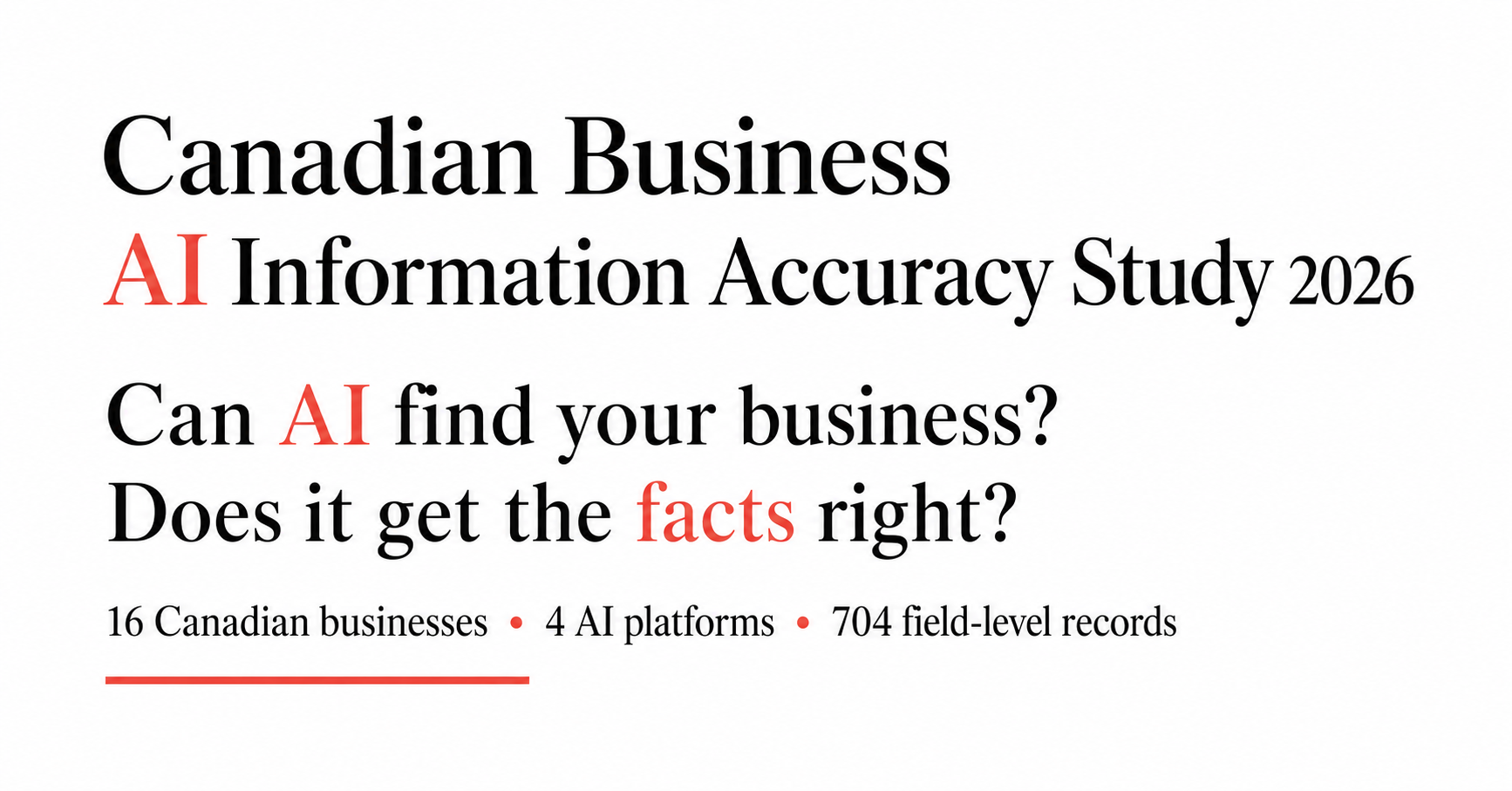
WebMax Canada’s Canadian Business AI Information Accuracy Study 2026 tested 16 Canadian businesses across four AI platforms and 704 field-level records.
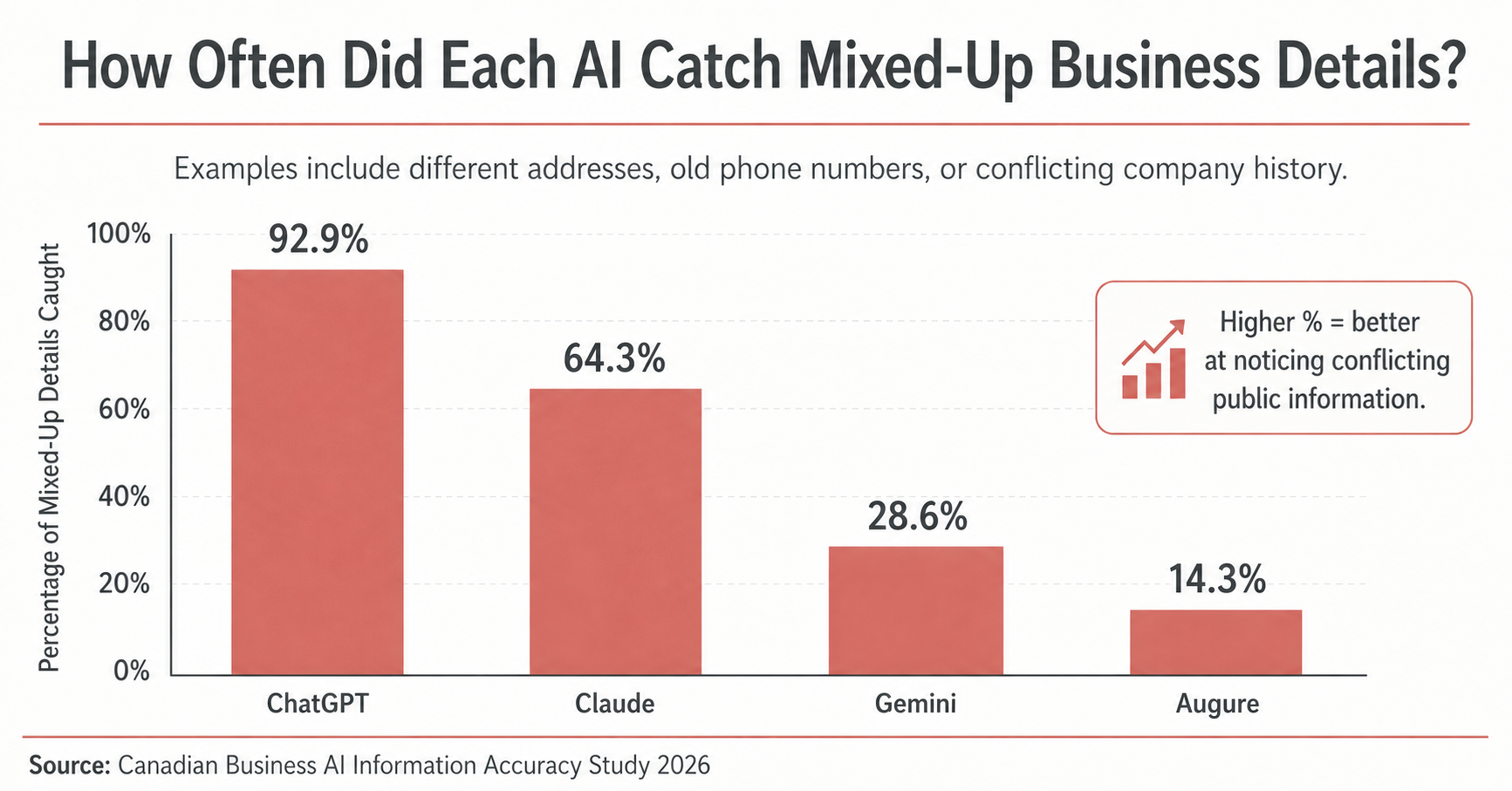
How often the tested AI platforms caught conflicting business information in WebMax Canada’s 2026 study. ChatGPT reached 92.9%, followed by Claude at 64.3%, Gemini at 28.6% and Augure at 14.3%. Augure had much lower overall research coverage.
Canadian study finds accuracy was high once the right business was found, but results varied when public information was old or conflicting.
Today, the company looked at the next question:
Once AI finds a Canadian business, does it actually get that business right?
The new Canadian Business AI Information Accuracy Study 2026 tested ChatGPT, Gemini, Claude and Canadian AI platform Augure using 16 real businesses from across Canada.
ChatGPT, Gemini and Claude were generally very accurate once they identified the correct business. Problems were more likely to appear when information was missing, outdated or different from what another public source reported.
“AI was usually good at finding straightforward business facts,” said Susan Jones of WebMax Canada. “The harder part was messy information. An old address might still be sitting in a directory, or a company might have two different versions of its history online. At that point, the AI has to decide what to trust.”
The study produced 64 business-platform observations and 704 field-level scoring records. Researchers checked business identity, official website, location, phone number, services, service area, company history, credentials and conflicting public information.
A reference answer key was prepared before platform testing began and kept separate from the AI responses being evaluated.
Claude recorded 100% factual accuracy on the scorable fields it answered, with 96.3% factual coverage.
ChatGPT recorded 99.2% factual accuracy, with 98.5% coverage.
Gemini recorded 96.9% factual accuracy, with 97.0% coverage.
All three correctly identified the intended business in all 16 cases.
Augure recorded 93.8% factual accuracy on the smaller number of fields it answered, but coverage was 17.8%. Several Augure sessions experienced search or result-delivery problems during testing, so WebMax Canada is treating that mainly as a coverage issue rather than evidence that the platform regularly supplied incorrect information.
Only two fields in the full locked scoring dataset were classified as outright incorrect.
The platforms separated more clearly when they had to deal with conflicting information.
Seven of the 16 businesses had known conflicts in their public information before testing began. These included issues such as different addresses, inconsistent company history and information that did not match across sources.
Under the study’s scoring method, ChatGPT identified or substantially preserved 92.9% of those conflict cases. Claude scored 64.3%, Gemini 28.6% and Augure 14.3%. Augure’s lower overall coverage limited how many conflicts it had an opportunity to identify.
“Finding one believable answer is not the same as noticing that two credible sources are saying different things,” Jones said. “That matters when someone is using AI to research a company they may be thinking about calling, hiring or buying from.”
Two studies, two questions
WebMax Canada’s first study, released August 11, looked at whether Canadian contractors appeared when ChatGPT, Gemini and Claude were asked for local business recommendations.
That study found that 66.8% of the market-specific businesses identified appeared on only one of the three AI platforms, while just 11.2% appeared across all three.
Yesterday’s study asked:
Can AI find your business?
Today’s asks:
If AI finds your business, is the information right?
For Canadian businesses, the two studies point to two jobs: make sure AI can find you, and make sure the information it finds is right.
A company can have accurate information online and still not appear in an AI recommendation. It can also appear in AI research while being described with old, incomplete or conflicting information.
“Being found is only part of it,” Jones said. “A business also needs the information AI finds about it to make sense.”
Why Canadian information matters
WebMax Canada conducted both studies because Canadian businesses should have Canadian evidence to work from.
Much of the research around AI search focuses on U.S. companies, global brands or international datasets. That work can be useful, but it does not necessarily show what is happening to Canadian businesses in Canadian markets.
These studies offer a starting point based on real Canadian companies.
For business owners, today’s findings are also a reminder to check what the public internet says about the company.
Old directory listings, previous addresses, outdated phone numbers and conflicting business descriptions can remain online long after a company has changed them.
Businesses cannot control every website that mentions them. They can keep the information they do control clear and current, and correct important listings where possible.
“We are not telling Canadians not to use AI,” Jones said. “People are already using it. We want Canadian businesses and consumers to have Canadian evidence about what these systems do well and where they can still get tripped up.”
About the Study
The Canadian Business AI Information Accuracy Study 2026 is a human-led, AI-assisted observational study conducted by WebMax Canada.
Testing took place on August 12, 2026 using a frozen sample of 16 Canadian businesses, standardized research instructions and a reference answer key prepared before platform testing.
The businesses are not being publicly identified. They did not commission, approve or review the research, and the company-level findings remain under embargo.
Results reflect the platform experiences observed during the testing period. AI platforms, search systems and public business information can change over time.
About WebMax Canada
WebMax Canada is a 100% Canadian web design, SEO and AI Visibility company serving contractors, trades, service businesses and other Canadian companies.
WebMax Canada is also the company behind SpottableAI™, its AI Visibility service for Canadian businesses.
WebMax.ca | SpottableAI.ca
250-217-5340 | 800-478-1030
Media Contact
Susan Jones
WebMax Canada
250-217-5340
Susan Jones
WebMax Canada
+ +1 250-217-5340
email us here
Visit us on social media:
LinkedIn
Bluesky
Instagram
Facebook
YouTube
X
Legal Disclaimer:
EIN Presswire provides this news content "as is" without warranty of any kind. We do not accept any responsibility or liability for the accuracy, content, images, videos, licenses, completeness, legality, or reliability of the information contained in this article. If you have any complaints or copyright issues related to this article, kindly contact the author above.
